
The unequal contribution of greenhouse gas emissions by industrialized countries is accompanied by unequal distribution of the associated climate risks with regions contributing least to emissions being prone to be hit the hardest by climate change. It is in that sense that the concept of Climate Justice arises. Oxfam MENA has identified climate justice as a priority issue for its work in the MENA region in the coming years requiring consulting services to conduct a study that places particular emphasis on inequality, fragility, conflict sensitivity and gender dimensions to enable Oxfam MENA to identify relevant actors, determine areas where the organization could add value, and recognize potential risks, challenges and barriers.
Activities
Ecocentra was assigned by Oxfam MENA to conduct this study, which commenced with a literature review and in-depth meetings with Oxfam country offices to determine the scope of the analysis and narrow down to specific themes of interest that are climate justice interlinkages with the Water Energy Food Security nexus, Water Sanitation and Hygiene and vulnerable groups. The team mapped the current potentials in the MENA region in terms of Climate Justice and Climate Change and identified relevant existing regional strategies. The study also mapped international and regional organizations working on projects targeting climate change, security, and justice challenges in the MENA region.
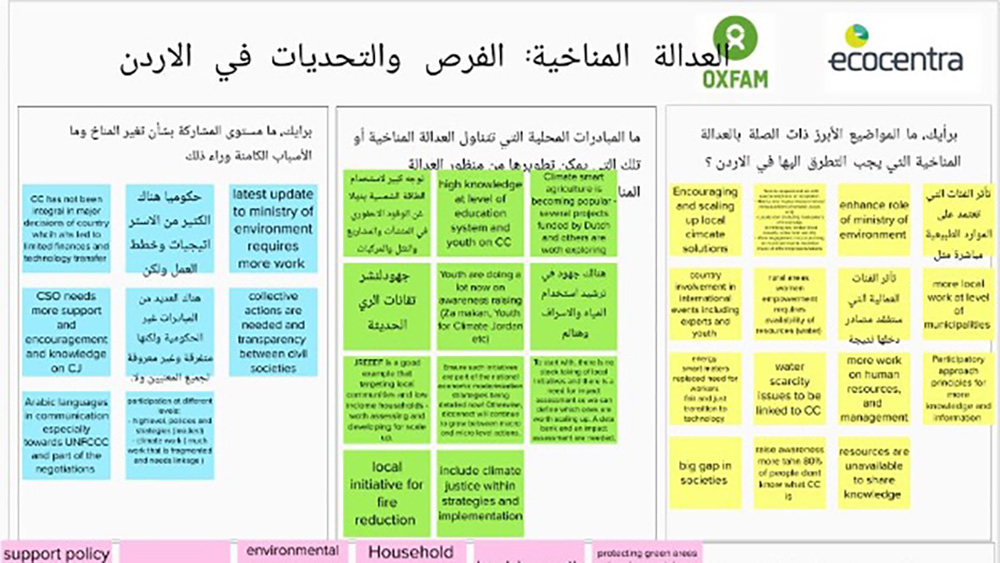
The next step involved zooming in at country level with focus on Egypt, Iraq, Jordan, Lebanon, Palestine, Syria and Tunisia. As such, a brief overview of country level status and challenges together with climate change risks and vulnerabilities was researched for each country. In addition, a review of major national strategies was presented to identify whether climate change, specifically climate justice, is considered. Stakeholder mapping was conducted to identify active organizations and potential partners at the national level. The team then conducted virtual focus group discussions with civil society activists, researchers, youth and women representatives to identify the major blockers to effective participation in climate justice initiatives, to obtain their recommendations for climate justice work in the country and to support the literature review. Finally, the team analysed the findings to identify climate justice hotspots, options for Oxfam intervention areas for the region, with country specific recommendations, options for multi-country program engagement for Oxfam and potential partners and target groups.